
'Do What You Will'
Sex and politics in the 18th century
As I’ve mentioned before, I’m playing with the idea of a fourth Galbraith & Pole book. I’m thinking of featuring a 21st century version of the Hell-Fire Club. Because I generally write historical fiction, research is something I see as important even in something as fantastical as the Galbraith & Pole stories. So I’ve been reading Geoffrey Ashe’s book on the Hell-Fire Club.
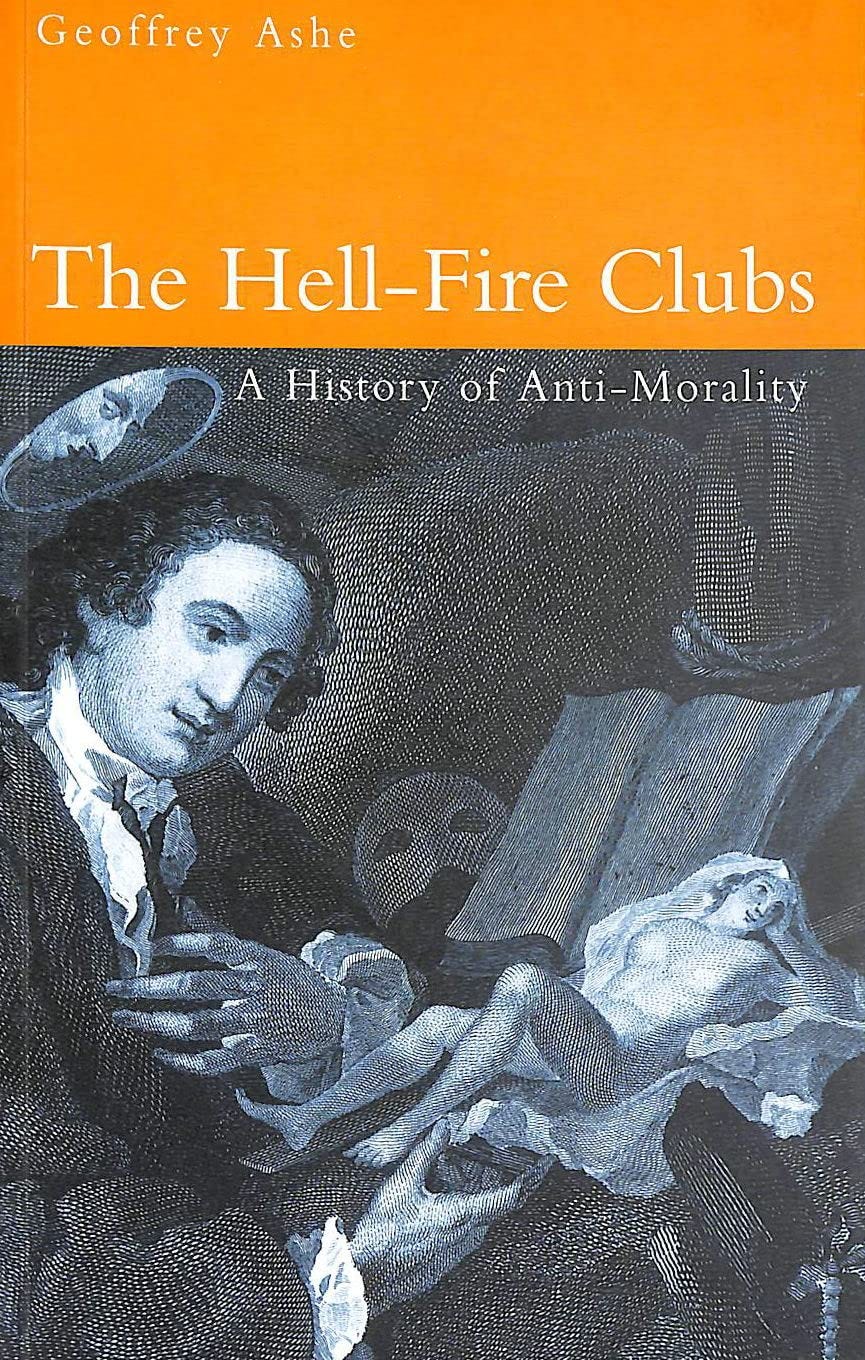
What I started as a little light reading about an 18th century club turned into a voyage through Georgian sexuality, politics and philosophy with a side order of literature and some local characters. (I live near Richmond and this area seems to have been a hotbed of political intrigue and licentiousness three hundred years ago.) It raised enough interesting points (and disturbing parallels between then and now) for me to want to share the journey. Take a stiff drink and buckle up.
The book sprawls over a substantial territory. For starters, there were, it seems, several clubs in the 18th century that were often referred to as ‘Hell-Fire Clubs’. The one we most often associate with the name these days is not the original Hell-Fire Club (started by the Duke of Wharton around 1720) but ‘The Order of the Friars of St Francis of Wycombe’ founded by Sir Francis Dashwood around 1750.
The Hell-Fire Clubs generally shared a philosophy of ‘Do what you will’ and Dashwood had this carved into the doorway of the Club’s meeting place. They were generally associated with sexual licentiousness (and the book dwells on this at some length) but Dashwood’s club had a serious political intent. (The Hell-Fire Club in Galbraith & Pole, you may or may not be glad to hear, is definitely political rather than sexual in its focus.) The clubs were secret societies in which rich and well-connected people politicked against the government of the day. Remember we’re in the Georgian era: all the rich and well-connected people knew each other and politics was as much about personal relationships and feuds as about actual policy. (The more I learn about the Georgians, the more I think we are currently reliving the 18th century. I’m not sure this is really a good thing.) To a degree, the Hell-Fire Club was a gathering of younger, disillusioned people who felt they could not get on in politics which was in the increasingly sclerotic hands of the Whigs who showed no signs of ever letting younger politicians anywhere near power. They were not, however, totally without influence. Several were, or became, MPs and it is rumoured that in its early days the Prince of Wales (whose antipathy to his father, George II made him a natural magnet for political rebels) was a member.
The book explores various of the political plots and intrigues of the time. My old friend Henrietta Howard isn’t mentioned although Horace Walpole, a near neighbour and frequent visitor of hers, features as one of the rebel circle. He visited the Club’s headquarters at Medmenham Abbey and left us a description of it, although he was never a member. He had his own fantasy world based at Strawberry Hill. Ashe discusses him and his overlapping interests at some length, though in the end Horace became the sort of Establishment Whig he had used to despise.
Having looked at the history and political and social backgrounds to the British Hell-Fire Clubs, Ashe’s book turns suddenly towards France and another figure who preached rebellion against both sexual and political convention: the Marquis de Sade. Sensitive readers may choose to turn away at this point. I nearly did but then I decided to stick with it and I’m glad I did.
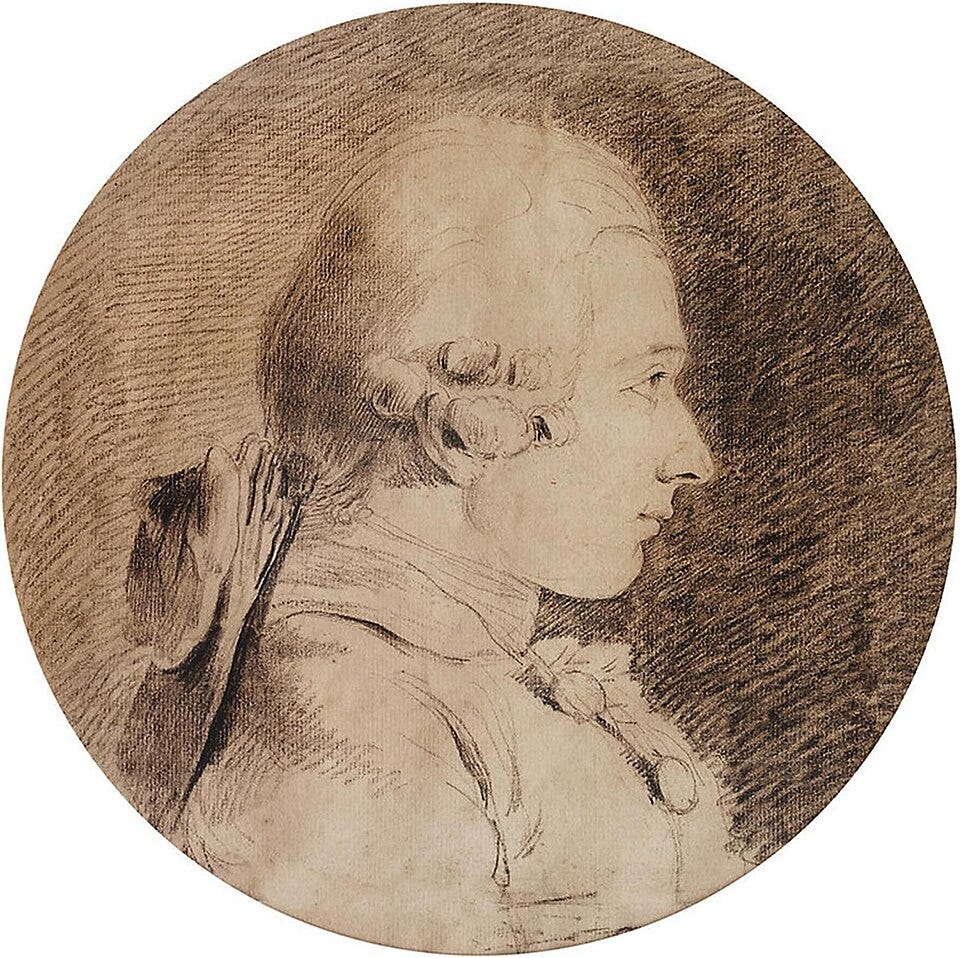
The Marquis de Sade is one of those people everyone seems to have heard of but few people can tell you much about. Born in 1740, he served in the Seven Years War and returned to marry one Renée de Montreuil. She seems to have been a remarkably patient wife, tolerating the fact that he spent long periods living with his mistress. This may not have been that shocking amongst the 18th century French aristocracy, but the fact that his mistress was his wife’s sister did raise eyebrows. It is fair to say that relations with his mother-in-law were not good. In fact, it was his mother-in-law’s continual complaints about his behaviour that ended up in his spending many years in prison and dying in a lunatic asylum.
De Sade was clearly, for want of a better phrase, a sexual pervert, and not a very nice man. What made him stand out, though, was his whole-hearted commitment to the motto of ‘Do what you will’. Like the most extreme of the ‘sovereign citizens’ of today’s United States, who interpret Libertarianism as meaning that the state should have no control over them, de Sade did not accept that any other being could have a right to criticise him or curtail his freedom. The women he abused and raped disagreed and eventually, thanks largely to the efforts of his mother-in-law, he ended up in the Bastille. Later, he was sent to a lunatic asylum, where he died in 1814.
While he was in the Bastille, he wrote his magnum opus, ‘The 120 Days of Sodom’ (written in tiny manuscript on small pieces of paper he glued together into a scroll, no regular writing paper being available). Later he produced two other significant works, ‘Justine’, which describes, in forensic detail, the sexual abuse suffered by a woman who sought only to be godly and good, and a companion piece, ‘Juliette’, following the adventures of a libertine who devotes herself to pleasure at the expense of everyone around her. The books are a nightmare of sexual horrors but it’s fair to say that Justine suffers more than Juliette which suggests de Sade believed that good people deserve more misery than those who honestly yield to their most depraved desires.
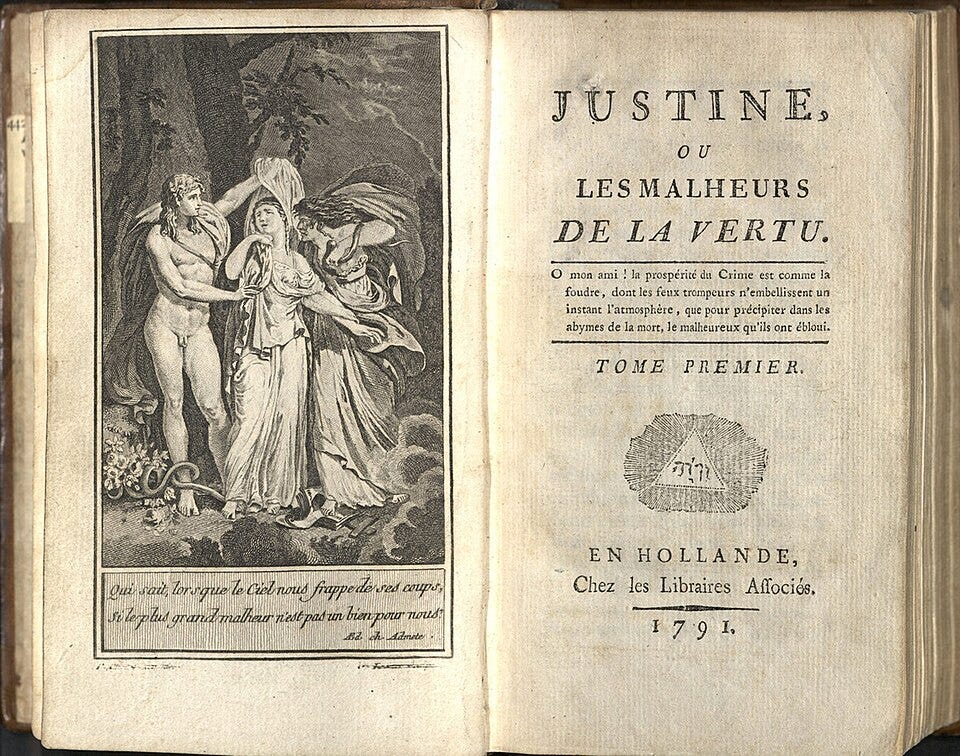
De Sade’s sexual fantasies (unfortunately they weren’t always fantasies, but let’s not go there) would just be some rather unpleasant dirty books, but like Dashwood and his fellow free-thinkers, de Sade mixes politics into his sexual writings.
He took his politics seriously. At one point, between his various times in prison, he served in public office in his Paris neighbourhood (the Section des Piques, near what is now the Place Vendôme) rising to be elected president of the neighbourhood. (In a darkly comic twist, he was voted onto a three man committee which was charged with inspecting girls orphanages. Surprisingly, he seems to have done a respectable job.) Radio 4’s The Rest is History suggests that de Sade is “one of the great subterranean influences on the development of European culture and thought.” He gave copies of ‘Justine’ and ‘Juliette’ to the five man Directorate that governed France after the Terror. One can only imagine what they must have made of it. Despite his aristocratic background, his views tended to the left. (At least, that is Ashe’s view, though de Sade’s philosophy seems to be one of those that runs so far left that the result sits comfortably on the extreme right.) In his 1795 pamphlet ‘One More Effort’ he argues that it is wrong to have general laws at all because human beings vary so much. Legislating is like to trying to dress an army in uniforms all the same size. He doesn’t want to restructure the system in the name of morality. The intensely moral Robespierre, he argues, was the worst of tyrants. The answer is not to make supposedly better laws but to have as few laws as possible. De Sade defends every sort of crime as justified sometimes and therefore not to be put under a blanket ban: theft, murder and, of course, sexual misconduct.
De Sade genuinely wanted to set up a private kingdom where he could put his theories into practice. Indeed, before he was imprisoned, he tried to do so. In the winter of 1774-5, he set up his own harem. He took on a carefully chosen chambermaid and other young female staff, several handsome man servants, and an equally delightful male secretary and female cook. It all fell apart, of course. The servants gave notice. The secretary’s parents told him to come home. The chambermaid left in an advanced stage of pregnancy, and the cook’s father appeared on the doorstep with a gun. After his time in prison, his Libertine experiments were confined to literature.
In ‘Juliette’ one of the characters, a Russian called Minski, lives in a remote castle on an island surrounded by a forest. He is forty-five and, in Ashe’s summary, “He has travelled through most of the world studying the vices of every nation, and committing every crime in safety himself under the protection of immense wealth. He now dwells in this Italian fastness, with a lavish establishment of both sexes but no equal. His only companions not subject to him are guests who come and go, chosen for their probable willingness to join in the fun.”
The more I read of de Sade’s fantasy world, the more disturbingly familiar it seemed. A remote island where young people (de Sade had a thing for young – sometimes very young – victims in his writing) are available to be abused by a very rich man and his invited guests who consider that laws simply don’t apply to them. Does that make you think of anything in the news? It seems another way in which the 21st century is reverting to the 18th and I can’t say I like it.
A more acceptable side of Georgian history
I did get away from de Sade and his perversions for a literal breath of fresh air at the weekend, while still living the Georgian dream. The photo shows the remains of launching slips at Buckler’s Hard, a place where many of the wooden walls of England were built from 1698 to 1818. It’s on the banks of the Beaulieu River, just outside Southampton, and was a major shipyard. Nowadays, it’s a lovely place for an afternoon’s walk. There’s a museum which closes quite early (and a pub that serves good food rather slowly) so I’ll be going again and coming back with more pictures from the 18th century, but I thought I’d leave you with this scene as a mind-cleanser after all the dubious philosophy of the period.

Well, they say that there is nothing new in the world; pointing out the parallels between Epstein and co demonstrates this. I'm almost beginning to look forward to a resurgence of Puritanism. I tried reading de Sade in my teens and gave up. Thanks for another thought-provoking article.
Oh - and if you're ever minded for some seriously gentle and old-fashioned reading, Elizabeth Goudge's Damerosehay books are set around Buckler's Hard.